The running briefing.

From the start line to the long run.
Running news, without the extra miles.

Headlines and opening paragraphs from running’s independent voices and leading publications. Find your next read, then go straight to the source.

How this works

Original-language articles only. No automatic translation or mixed-language feed.

Your reading list

10 stories found

Showing your selected publishers and topics.

Clear filters

British women’s marathon record progression (opens in a new tab)

The British women’s marathon record progression begins with Violet Piercy’s time of 4:25 in an unofficial run in 1936. It ends with Paula Radcliffe’s 2:15:25 in 2003. For most of the twentieth century women were not permitted to run marathons. Victorian women were told they should avoid vigorous activity as it would endanger their fertility. These widely held views limited the development of women’s sport, particularly athletics, for decades.
Read at RunYoung50 (opens in a new tab)Marathon

Sarah Webster & Sandra Brown at the Crawley 24 Hour Track Race (opens in a new tab)

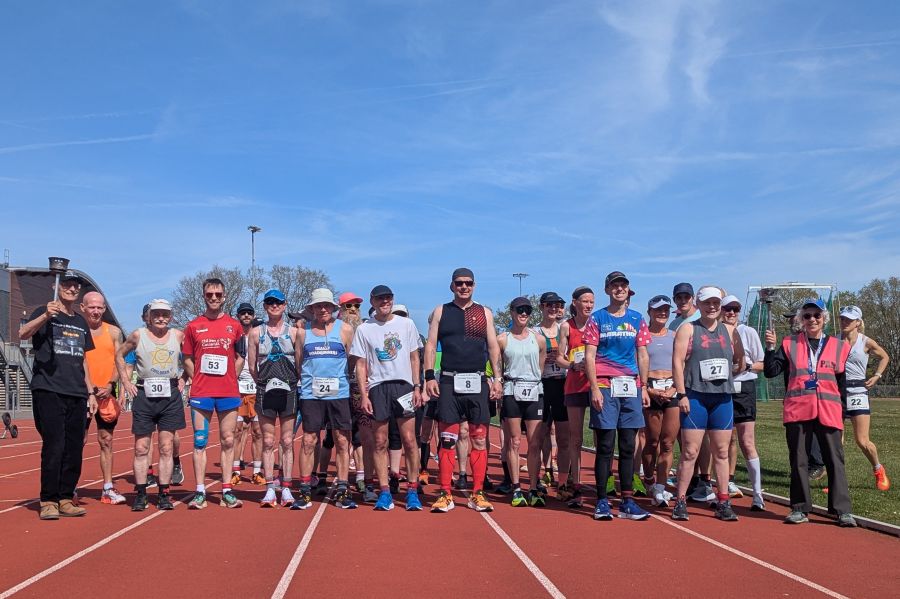
Very early in the morning on Sunday 13 April 2025, something extraordinary happened at the Crawley K2 arena. Sarah Webster, competing in her first 24-hour race, crossed the timing mat of the floodlit 400-metre athletics track for the 403rd time. It was just after 2 a.m. and Sarah had run 100 miles in 14 hours 5 minutes and 5 seconds, a new British record. There was no fanfare, no race photographer, no pause to celebrate. Instead, there were cheers from the small band of race officials and volunteers who were near the timing mat, a blurry photo taken by me, and Sarah carried on running – for the remaining ten hours, she was going to push herself even harder. But hers was not the only record set during the race. Another extraordinary woman was competing – race walker Sandra Brown, holder of multiple age group world records.

Read at RunYoung50 (opens in a new tab)Trail & ultra

Clare Ford – Lymphoma and Fighting Fit (opens in a new tab)

Clare Ford from Grantham grew up loving sport, playing netball and hockey, and doing track and field athletics. She started running regularly in her thirties. But in her early fifties Clare was stopped in her tracks by a shock diagnosis. Six months into the Covid pandemic she was told she had Non-Hodgkin Lymphoma, a cancer of the lymphatic system. Following treatment, Clare has found her way back to fitness and to running. On 27th April 2025, she will be running the London Marathon, raising funds for Lymphoma Action, the charity which helped her to cope with her diagnosis and treatment.

Read at RunYoung50 (opens in a new tab)Training

Top 10 posts in 2024 (opens in a new tab)

Here are the top ten posts on RunYoung50 in 2024. Several of them are also amongst the ten most popular posts since I started this blog in February 2014. RunYoung50 started as an investigation into the experiences of women runners over 50. You can find those first interviews here. My first post about the history of women’s distance running appeared in September 2014. As I’ve become more and more interested in running history, I’ve shared much of my research on here.

Read at RunYoung50 (opens in a new tab)Racing

Edith Couhé – women’s six day races – part 6 – October 1984 (opens in a new tab)

This is part six of a series of posts about the development of women’s six day running races. In 1984, the six day record changed hands five times. Firstly, Christine Barrett set a new record in the UK in May. Next, Mary Hanudel broke Barrett’s record in the USA in June. Then, at the New York Six Day Race in July, Eleanor Adams regained the record she had held at the start of the year. She held it for three months before French race walker Edith Couhé broke the record at the La Rochelle Six Day Race in France in October.

Read at RunYoung50 (opens in a new tab)Trail & ultra

Women’s six day races – world record progression (opens in a new tab)

The history of women’s six day ultra races has been overshadowed by the focus on the men’s record. The impetus for writing a series of posts about the women’s six day record came from interviewing Eleanor Robinson and Lorna Richey Michael who both competed in the New York Road Runners Six Day Track Race in 1984. I realised that 1984 was a stellar year in the history of the women’s event. The record changed hands five times and women drove the distance up by 91 miles in just 8 months. There hasn’t been a year like it before or since.

Read at RunYoung50 (opens in a new tab)Trail & ultra

Mary Hanudel – women’s six day races – part 5 – June 1984 (opens in a new tab)

This is part five of a series of posts about the development of women’s six day races from 1981 onwards. In 1984, the six day record changed hands five times. Four women extended the distance by 91 miles that year. The first was British ultrarunner Christine Barrett at Stoke-on-Trent. This is the story of the second woman to set the record that year, American Mary Hanudel.

Read at RunYoung50 (opens in a new tab)Trail & ultra

Christine Barrett – women’s six day races – part 4 – May 1984 (opens in a new tab)

This is part four of a series of posts about the development of women’s six day races from 1981 onwards. The series documents the women who set the world record for six days. In 1981, Marcy Schwam of the USA became the first woman to compete in a six day race since the revival of the format in 1980. Her “new era” record of 384 miles was broken in 1982 by 23-year-old British runner, Ros Paul, with a distance of 407 miles 741 yards. In 1983, Eleanor Adams extended the record a little when she ran 409 miles 1178 yards. 1984 was the stellar year for women’s six day racing. The record changed hands five times. British ultrarunner Christine Barrett was the first of the four women played a part in driving up the record by 91 miles.

Read at RunYoung50 (opens in a new tab)Trail & ultra

Eleanor Adams – women’s six day races – part three – 1983 (opens in a new tab)

This is part three of a series of posts about the development of women’s six day races from 1981 onwards. The series documents the women who set the world record for six days. In 1981, Marcy Schwam of the USA became the first woman to compete in a six day race since the revival of the format in 1980. Her “new era” record of 384 miles stood for just over a year. For the next two years, Nottingham was the place where the record was rewritten. Firstly, in 1982, when 23-year-old British runner, Ros Paul, broke Schwam’s record with a distance of 407 miles 741 yards. Secondly, in 1983, when Eleanor Adams ran 409 miles 1178 yards.

Read at RunYoung50 (opens in a new tab)Trail & ultra